
Understanding Mercury in Soil
Mercury occurs naturally in the environment, but human activity can add much larger amounts to local areas. Once released, mercury can be found in water, soil, air, and living systems. This makes mercury in soil an important issue for environmental laboratories, industrial facilities, researchers, and agencies that monitor contaminated sites or evaluate potential releases.
Testing is needed because a soil sample can contain mercury in several chemical forms, and those forms do not behave the same way. The same site can also show meaningful differences between surface soil and deeper material, making representative collection an important part of the analytical process. A useful result depends on more than placing soil into an instrument. Sampling location, sample handling, preparation, analytical technique, quality-control steps, and the purpose of the test all affect how the result should be interpreted. Understanding those pieces helps laboratories select a measurement approach that fits the sample and the monitoring objective.
Where Mercury in Soil Comes From
Mercury can reach soil through both natural and human sources. Volcanic and geothermal activity can release mercury to the atmosphere, where it may later return to land through wet or dry deposition. Weathering of mercury-bearing rock also contributes small amounts in some locations. Forest fires and other natural processes can release mercury that was already stored in vegetation or surface soils, allowing it to circulate again through the environment.
Human activity can create much more concentrated local sources. Coal combustion, mining, metal processing, waste handling, and other industrial operations have all been linked to mercury releases. Artisanal and small-scale gold mining can be especially important in regions where mercury is used to separate gold from ore. Historic mining districts, former industrial properties, spill locations, and areas affected by past emissions may contain localized hotspots of mercury contamination. By contrast, background mercury is usually distributed at much lower levels across broad areas. Where mercury is most likely to be found therefore depends heavily on site history, nearby emission sources, geology, drainage, and atmospheric deposition. A site investigation should account for those factors before deciding that one sampling location represents the whole property.
Why Mercury Concentration and Chemical Form Matter
Laboratories often begin by measuring total mercury, which is the combined amount of mercury in a sample regardless of its chemical form. A total mercury result shows how much mercury is present overall, but it does not identify the specific mercury species in the sample.
There are multiple types of mercury, including elemental mercury, inorganic mercury compounds, and organic mercury compounds such as methylmercury. These mercury species differ in volatility, mobility, bioavailability, and toxicity. For many routine soil investigations, total mercury is the primary measurement. More specialized analysis may be needed when the chemical form itself is part of the research or risk question.
Soil conditions also affect mercury behavior. Organic matter and fine mineral particles can bind mercury and help retain it in the soil. Mercury may therefore be more concentrated in surface horizons that contain more organic material, although local geology and human inputs can change that pattern. Moisture, acidity, oxidation-reduction conditions, temperature, and microbial activity can influence how strongly mercury is held and how readily it can move or change form. Wet, low-oxygen environments are especially important because microorganisms can convert some inorganic mercury into methylmercury. That form is more readily taken up by organisms and can move through food webs. This is one reason mercury concentration alone does not always describe environmental behavior or exposure potential.
Mercury can remain in soil for long periods because it binds to soil components and can be recycled between land and the atmosphere. Some mercury may volatilize and return to the air, while other portions remain stored in organic-rich surface layers. Disturbance, erosion, runoff, changing moisture conditions, and land-use changes can alter how mercury moves. This persistence also means that a current measurement may reflect both recent inputs and older contamination retained at the site.
A result should therefore be interpreted in the context of previous land use, nearby sources, and the depth at which the sample was collected. Site history and local soil conditions matter when deciding where to collect samples and how often a site should be reassessed.
Environmental and Human Implications of Mercury-Contaminated Soil
High mercury contamination can affect soil organisms, vegetation, and nearby food chains. High concentrations may reduce microbial activity, interfere with root growth, and affect plant health. Inorganic mercury is often strongly associated with soil particles, so plant uptake can be limited in many settings. Still, mercury can move with eroded soil, runoff, or dissolved organic matter and contribute to mercury in water. Wetlands, streams, and other aquatic environments may support methylmercury formation and bioaccumulation.
Human exposure depends on the form of mercury and the way a site is used. People may ingest contaminated soil or dust accidentally, inhale contaminated particles, or inhale mercury vapor where elemental mercury is present and volatilizing. Workers at industrial or cleanup sites may face different contact patterns than residents, gardeners, or the general public, so exposure assumptions should match the setting. Mercury that reaches aquatic food webs can also create a separate dietary exposure route through contaminated fish and wildlife. Because exposure pathways vary by site, laboratory data should be considered alongside land use, site conditions, and the chemical form being evaluated rather than treated as a stand-alone measure of risk.
How Soil Samples Are Collected and Prepared for Mercury Testing
Reliable analysis starts with a representative sampling plan. The plan should define the question the project is trying to answer, such as establishing background conditions, locating a release area, evaluating a suspected hotspot, or monitoring changes after site work. Sampling locations, depths, and the number of samples should reflect that objective. Surface samples may be appropriate when atmospheric deposition or recent releases are the main concern, while deeper samples may be needed to evaluate buried material, historic fill, or movement through the soil profile. A single soil sample may not represent a large or variable property, so laboratories and field teams often use multiple locations, replicates, or composite sampling when the project design allows it. The sampling design should also preserve enough information to connect each laboratory result back to a specific location and depth.
Field practices are important because mercury can be present at low concentrations and contamination introduced during collection can distort results. Sampling tools should be clean and appropriate for the method, and teams should avoid contact with materials that could add mercury to the sample. Samples need suitable containers, clear labels, and records that document where and when they were collected. Field notes may also record soil condition, moisture, unusual odors, staining, nearby equipment, or other observations that help explain a result later. Chain-of-custody documentation is also common when samples are submitted to a laboratory for regulatory, legal, or quality-assurance purposes. The exact collection and preservation requirements should follow the analytical method and project plan rather than a one-size-fits-all procedure.
Preparation depends on the selected measurement technique. A laboratory may dry or freeze soil when a method calls for it, then homogenize or sieve the material so the test portion better represents the submitted sample. Cold-vapor methods generally require chemical preparation that converts mercury into a form that can be measured, often after digestion or oxidation. Direct thermal decomposition methods can analyze many solid samples without wet chemical digestion. In either case, blanks, reference materials, calibration checks, and recovery checks help the laboratory identify contamination, instrument drift, or matrix-related problems before results are reported.
Methods Used to Measure Mercury in Soil
The best analytical technique depends on the purpose of the test, expected mercury concentration, sample matrix, required detection limit, laboratory throughput, and any method specified by a regulatory program. A laboratory screening many routine soil samples may place greater weight on speed and sample preparation burden. A project focused on trace concentrations may place greater weight on sensitivity and contamination control. Regulatory work adds another requirement: the laboratory must use a method accepted for the sample type and program in question. Mercury-specific instruments are widely used because they are designed around the unusual physical and chemical properties of the element. For soil testing, laboratories commonly consider cold-vapor atomic absorption, cold-vapor atomic fluorescence, and direct thermal decomposition with atomic absorption. Other multi-element techniques, including ICP-MS, may also be used when they fit the laboratory workflow and method requirements.
Cold-vapor atomic absorption spectroscopy, or CVAAS, measures mercury after it has been converted to elemental vapor. The vapor passes through an optical cell, and the instrument measures absorption of light by mercury atoms. For solid and semisolid samples, EPA SW-846 Method 7471B describes a manual cold-vapor procedure for total mercury in materials that include soils, sediments, bottom deposits, and sludges. Because this approach requires chemical preparation before measurement, laboratories need to account for digestion steps, reagents, blanks, and potential matrix effects. That preparation can add labor, but it also supports established workflows used by many environmental laboratories. AGS Scientific lists the NIC RA-7000A as a CVAAS analyzer used with EPA methods that include 7471B. The key point is method fit: the instrument and preparation procedure have to work together for the sample matrix and reporting requirement.
Cold-vapor atomic fluorescence spectroscopy, or CVAFS, also measures mercury vapor, but it detects fluorescence emitted after mercury atoms absorb ultraviolet light. CVAFS is known for very sensitive trace-level mercury measurement and is commonly associated with water-focused methods such as EPA 1631E and 245.7. AGS Scientific offers the NIC RA-7000F using CVAFS with the ability to measure mercury by both methods, and it even includes an option to do both simulataneously. Those two methods should not be treated as soil methods simply because they measure mercury. A laboratory evaluating soil must match the technique and sample preparation to a method that actually applies to solids or to a validated laboratory procedure suited to the project.
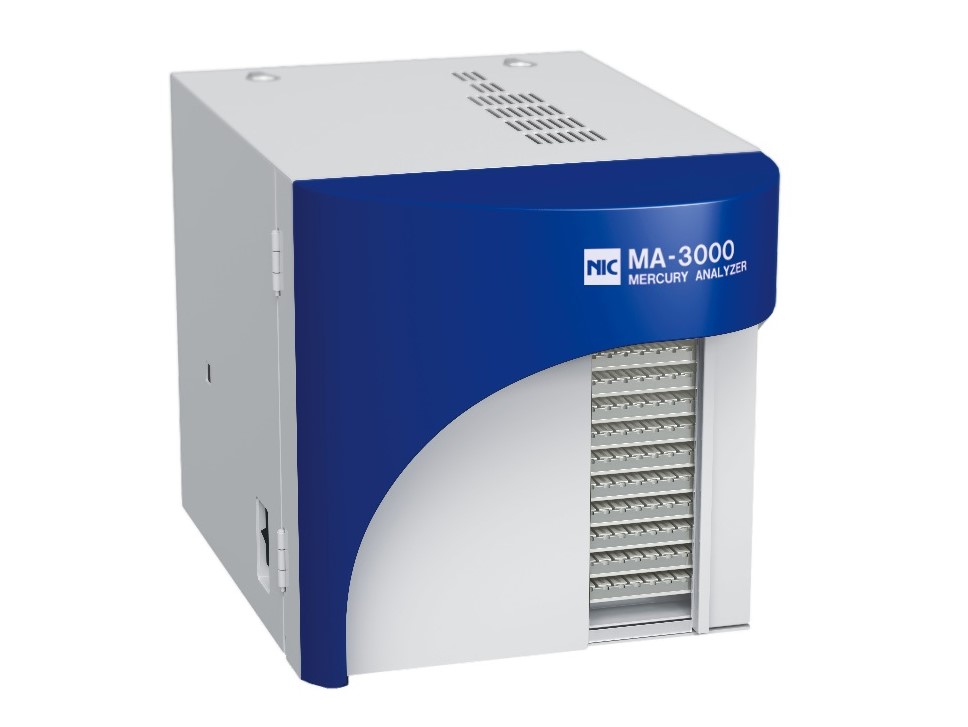
Direct thermal decomposition offers a different workflow for many solid samples. EPA SW-846 Method 7473 determines total mercury in solids and solutions by thermal decomposition, amalgamation, and atomic absorption spectrophotometry. In this approach, the sample is heated so mercury is released, the mercury is collected on an amalgamation trap, and the concentrated mercury is then measured by atomic absorption. Because the technique can accept solids directly, it can reduce wet chemical preparation and the use of digestion reagents. Less wet preparation can also reduce reagent handling and shorten the path between sample loading and measurement. AGS Scientific’s NIC product line includes the MA-3000, which uses direct mercury measurement by thermal combustion. Direct analysis isn’t automatically the right choice for every project. Laboratories still need to confirm that the instrument, procedure, calibration range, sample size, and quality-control plan meet the requirements of the project and any applicable method.
ICP-MS can also measure mercury as part of a broader elemental analysis program. Its value is often greatest when a laboratory needs results for several elements from the same prepared sample. Mercury can present analytical challenges, however, so laboratories need validated preparation, calibration, interference control, and quality-control procedures. For projects focused specifically on mercury, a dedicated mercury analyzer may offer a workflow designed around mercury chemistry rather than a multi-element platform.
Total mercury testing and mercury speciation answer different questions.
Total mercury is often the practical starting point for soil screening, site characterization, and routine monitoring because it quantifies the overall amount present.
Speciation or methylmercury analysis becomes more important when the project needs to understand mobility, bioavailability, chemical change, or ecological exposure.
Those analyses can require different extraction and measurement procedures, as well as stricter controls to prevent changes in mercury form during handling. A project may begin with total mercury and add speciation only when the site question calls for it. The laboratory should define the analytical question first, then select the method that produces data suitable for that purpose.
Reliable Testing Starts With the Right Method
Mercury testing is most useful when the field plan, sample preparation, analytical technique, and reporting requirements all support the same objective. A representative sample gives the laboratory a sound starting point, while suitable preparation and quality-control steps help produce data that can be interpreted for the site. Total mercury methods such as cold-vapor atomic absorption and direct thermal decomposition each have practical strengths, but their suitability depends on the sample and the governing method requirements.
For laboratories evaluating soil samples for mercury, method selection should begin with the matrix, expected concentration range, required sensitivity, sample volume, throughput needs, and applicable regulatory criteria. Matching those factors to an appropriate mercury measurement technique helps produce data that is useful for environmental monitoring, industrial decision-making, and further investigation when needed.
